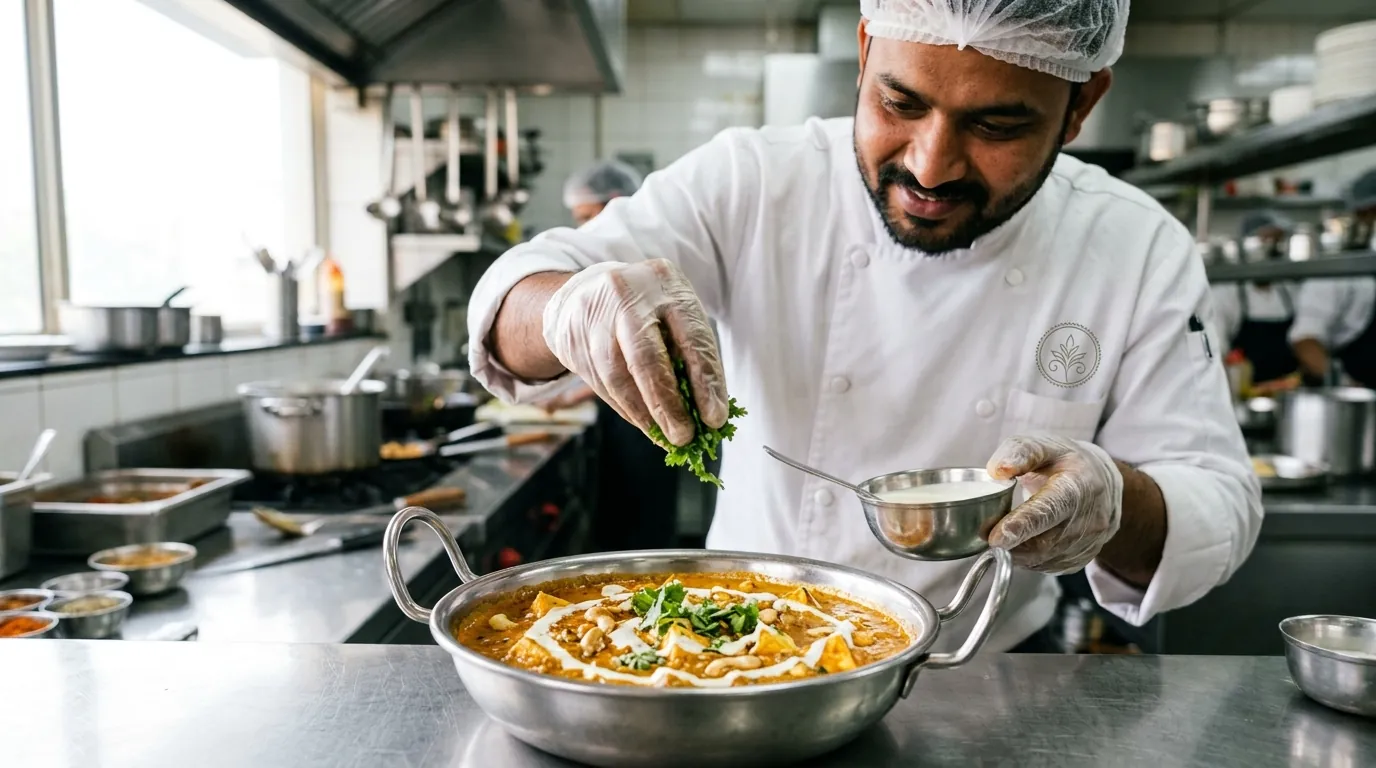
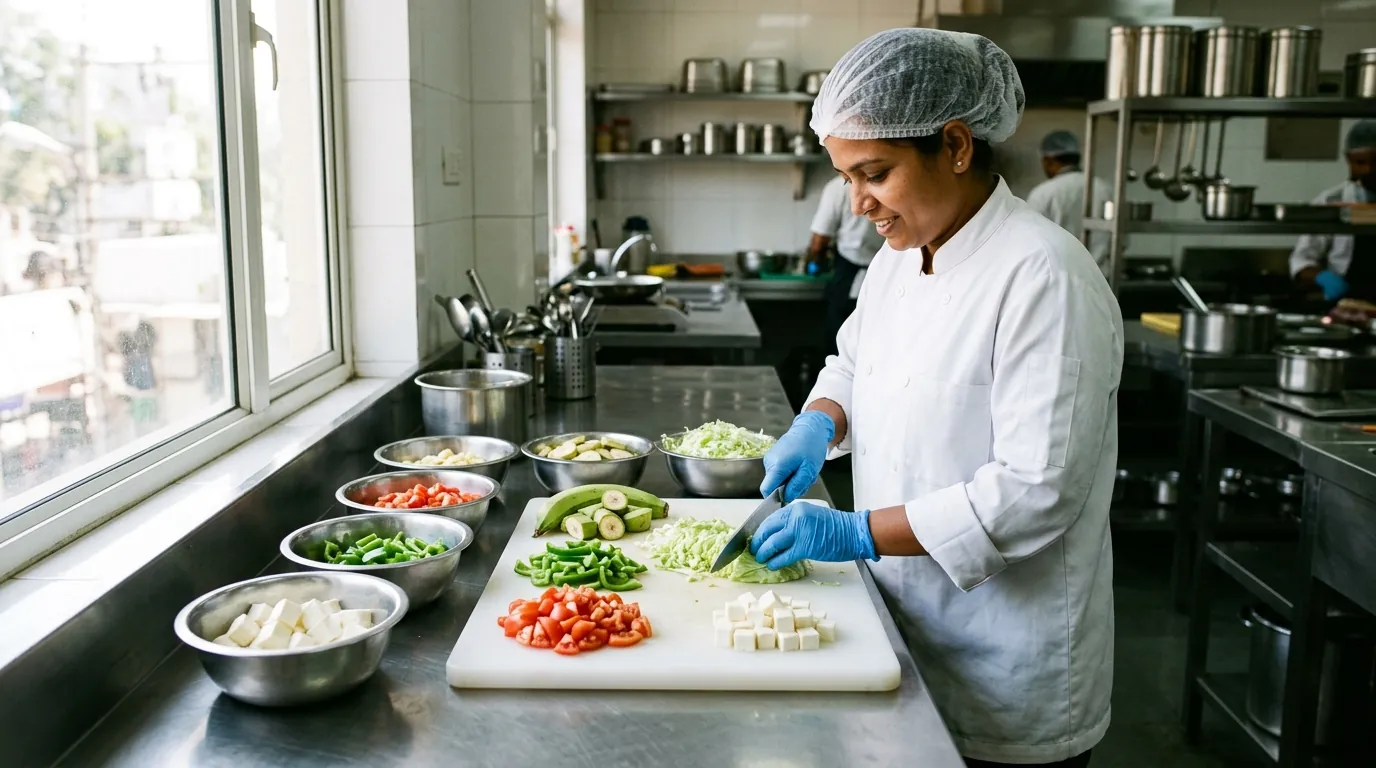
What can you eat on a Navratri vrat thali?
You can eat kuttu (buckwheat), singhare (water chestnut) and rajgira (amaranth) flours, samak rice, sabudana, potatoes, sweet potatoes, pumpkin, fruit and dairy, seasoned with sendha namak (rock salt) in place of table salt.
Most households cook in ghee or a plain oil such as groundnut, and flavour the food with jeera, green chilli, black pepper and fresh coriander. Every dish is made without onion and garlic.
| Food group | Commonly allowed | What it makes |
|---|---|---|
| Flours | Kuttu (buckwheat), singhare (water chestnut), rajgira (amaranth) | Puri, paratha, pakora, chilla |
| Grains and starches | Samak rice (barnyard millet), sabudana (tapioca pearls), makhana | Khichdi, vada, kheer |
| Vegetables | Potato, sweet potato, pumpkin (kaddu), bottle gourd (lauki), cucumber, tomato | Sabzi, raita, tikki, chaat |
| Dairy | Milk, curd, paneer, buttermilk, ghee | Raita, kheer, paneer sabzi, kadhi |
| Fruit and nuts | Seasonal fruit, peanuts, almonds, raisins | Fruit chaat, snacks, kheer topping |
| Salt and spices | Sendha namak, jeera, black pepper, green chilli, fresh coriander | Seasoning for all of the above |
Sources The Quint: Navratri fasting foods to eat and avoid, accessed
What should you leave off a Navratri vrat thali?
Leave off wheat flour, regular rice and other cereals, pulses and dals, onion, garlic, table salt, meat, egg and alcohol, which is the rule most North Indian households follow for the nine days.
Spices are where households disagree. One published guide lists hing (asafoetida), methi dana, coriander and garam masala among the spices to avoid, while other homes use some of them, so ask the elder who keeps the fast before you plan the thali.
- Wheat flour (atta), maida, sooji, besan and rice flour
- Regular rice, and every dal and pulse
- Onion and garlic
- Table salt: use sendha namak instead
- Meat, egg and alcohol
Sources The Quint: Navratri fasting foods to eat and avoid, accessed
What does a 9-day Navratri vrat thali plan look like?
A simple plan gives each day a different flour or starch, so no thali repeats: kuttu, sabudana, singhare, samak rice and rajgira each get a turn, with fruit and curd every day.
Day 1 is Sunday 11 October 2026 and Day 9 is Monday 19 October, as listed for Delhi by Drik Panchang. Ashtami and Navami both fall on 19 October that year and Dussehra is on 20 October, so check the timings for your town with your pandit.
| Day | Date | Main | Side and sweet |
|---|---|---|---|
| Day 1 | Sun 11 Oct | Kuttu puri with jeera aloo | Cucumber raita, samak rice kheer |
| Day 2 | Mon 12 Oct | Sabudana khichdi with peanuts and lemon | Plain curd, banana |
| Day 3 | Tue 13 Oct | Singhare puri with khatta-meetha kaddu | Dahi, makhana kheer |
| Day 4 | Wed 14 Oct | Samak rice with aloo-tamatar rassa | Cucumber raita, apple slices |
| Day 5 | Thu 15 Oct | Rajgira paratha with paneer-tamatar sabzi | Curd, singhare halwa |
| Day 6 | Fri 16 Oct | Kuttu dosa with aloo filling | Peanut-coconut chutney, fruit chaat |
| Day 7 | Sat 17 Oct | Sabudana vada with green chutney | Curd, sweet potato chaat |
| Day 8 | Sun 18 Oct | Samak rice with vrat kadhi (curd and singhare flour) | Aloo tikki, lauki halwa |
| Day 9 | Mon 19 Oct | Fruit and curd, then kanjak prasad after the pujan | Makhana kheer |
Sources Drik Panchang: festivals in Ashwina 2026 (Navratri, Ashtami, Navami, Dussehra), accessed
Is kuttu atta safe to buy for Navratri?
Kuttu atta is safe when it is fresh and stored well, but buckwheat flour has been linked to mass food poisoning during Navratri fasts, so buy it with care.
In September 2025 about 150 to 200 people in north-west Delhi fell ill after eating buckwheat flour during the fast, and officials urged buyers to use reliable stores and to look for proper labels and certifications. In April 2022 more than 70 people fell ill in Ambala and Yamunanagar in Haryana, and officials suspected adulterated flour.
A few habits lower the risk:
- Buy packed flour with a printed packing date and the maker's address, not loose flour from an open sack.
- Buy for the week, not for the month: ground buckwheat goes stale faster than wheat flour.
- Keep it airtight and cool, and smell it before use. Sour, musty or bitter flour goes in the bin.
- Knead the dough fresh for each meal, and do not eat food made from dough that was left out overnight.
- If anyone has vomiting or stomach pain after a kuttu meal, stop eating it and get medical help.
Sources The Tribune: 200 fall ill after eating buckwheat flour during Navratri fasting in Delhi (24 September 2025), accessed · The Tribune: over 70 fall ill in Ambala and Yamunanagar after eating food made of kuttu flour (April 2022), accessed
What can you prepare ahead for a nine-day vrat?
Soak the sabudana, make the chutneys and boil the potatoes the evening before, and leave only the flour dough and the frying for the meal itself.
That split keeps the thali fresh and the morning short, and it matches the flour safety habits above.
| Task | When | Why |
|---|---|---|
| Rinse and soak sabudana, then drain well | Evening before, 4 to 6 hours or overnight | Soaked pearls cook soft and separate instead of clumping |
| Boil potatoes for sabzi, tikki and dough | Evening before | Cooled boiled potato is easier to mash and shape |
| Make green chutney and peanut chutney | Evening before | Flavours settle overnight |
| Set curd for raita and kadhi | Morning of the day before | Fresh set curd is mild, older curd turns sour |
| Knead kuttu or singhare dough | At the meal, never ahead | The flour is the part that spoils, so it stays fresh |
What is kanjak prasad, and is it vrat food?
Kanjak prasad is halwa, chana and puri offered to young girls at kanya pujan, and it is not vrat food, because it uses sooji, wheat flour and chana that a vrat thali leaves out.
Families usually hold kanya pujan on Ashtami or Navami, and in 2026 both fall on 19 October in the Delhi calendar. Many families break the fast with this prasad after the pujan, so the fasting thali for that day stays light.
For the plate, plan about 100–120 g halwa, 80–100 g chana and 2–3 puris per girl. Bigger pujans and packed plates are on the kanjak prasad page.
| Girls | Halwa | Chana | Puris |
|---|---|---|---|
| One plate | 100–120 g | 80–100 g | 2–3 |
| Nine girls | 0.9–1.1 kg | 0.7–0.9 kg | 18–27 |
Questions families ask
Are potatoes allowed in a Navratri fast?
Yes. Potatoes and sweet potatoes are among the most common vrat vegetables. Boil, roast or shallow-fry them in ghee or oil and season them with sendha namak.
Can I drink milk and eat curd during the Navratri fast?
Yes. Most households allow milk, curd, paneer, buttermilk and ghee, and they supply much of the protein on the thali because dals are left out.
Is sabudana allowed in Navratri vrat?
Yes. Sabudana (tapioca pearls) is a standard vrat food, eaten as khichdi, vada or kheer. Soak it well and drain it before cooking so it does not set into a lump.
Can I use regular salt on a Navratri thali?
No. Use sendha namak (rock salt) in every dish, including the raita and the chutney, in place of table salt.
Which flour makes the best Navratri puri?
Kuttu and singhare flour both make puri. Kneading boiled potato into kuttu dough helps it hold together while rolling and frying.
Kanjak prasad for Navratri Festival orders and bulk sweets Langar and bhandara catering
Next on the calendar
Karva Chauth sargi items list: what goes in the thali
What goes in a sargi thali, how to balance it for a day-long fast, and the date for Karva Chauth 2026.
5 min read Order: Festival orders and bulk sweets
Diwali party menu ideas for home and office
Starters, mains, breads and sweets for a Diwali party at home or the office, and how to keep the menu short and good.
4 min read Order: Small party catering
Diwali sweet boxes for corporate gifting
How a corporate Diwali sweet box is put together, and how to order the sweets by the kilo.
Festival order